Getting your cover rejected by Amazon KDP is one of the most frustrating roadblocks in self-publishing. You have spent weeks writing your book, and now a technical spec error is holding your launch hostage. The good news is that KDP cover requirements are not mysterious. They are exact, and once you know the numbers, you can build or outsource a cover that sails through review every single time.
This guide gives you the exact dimensions, bleed settings, resolution targets, and file formats Amazon expects for every KDP book type. Bookmark it, use it as a checklist, and stop guessing.
Why One Pixel Off Can Cost You a Launch
Amazon's print-on-demand system is automated. Your cover file is checked by software, not a human with a flexible eye. If your spine is 0.02 inches too narrow, or your bleed is missing by a hair, the file gets rejected. Worse, some errors slip through review and show up as misaligned covers on customer orders, which leads to bad reviews and returns.
The most common rejection reasons are all preventable: incorrect trim size, missing bleed, low resolution images, and text placed too close to the edge. This guide removes every one of those risks.
Kindle Ebook Cover Requirements
Ebook covers are the simplest KDP format, but they still have strict standards.
Recommended Dimensions
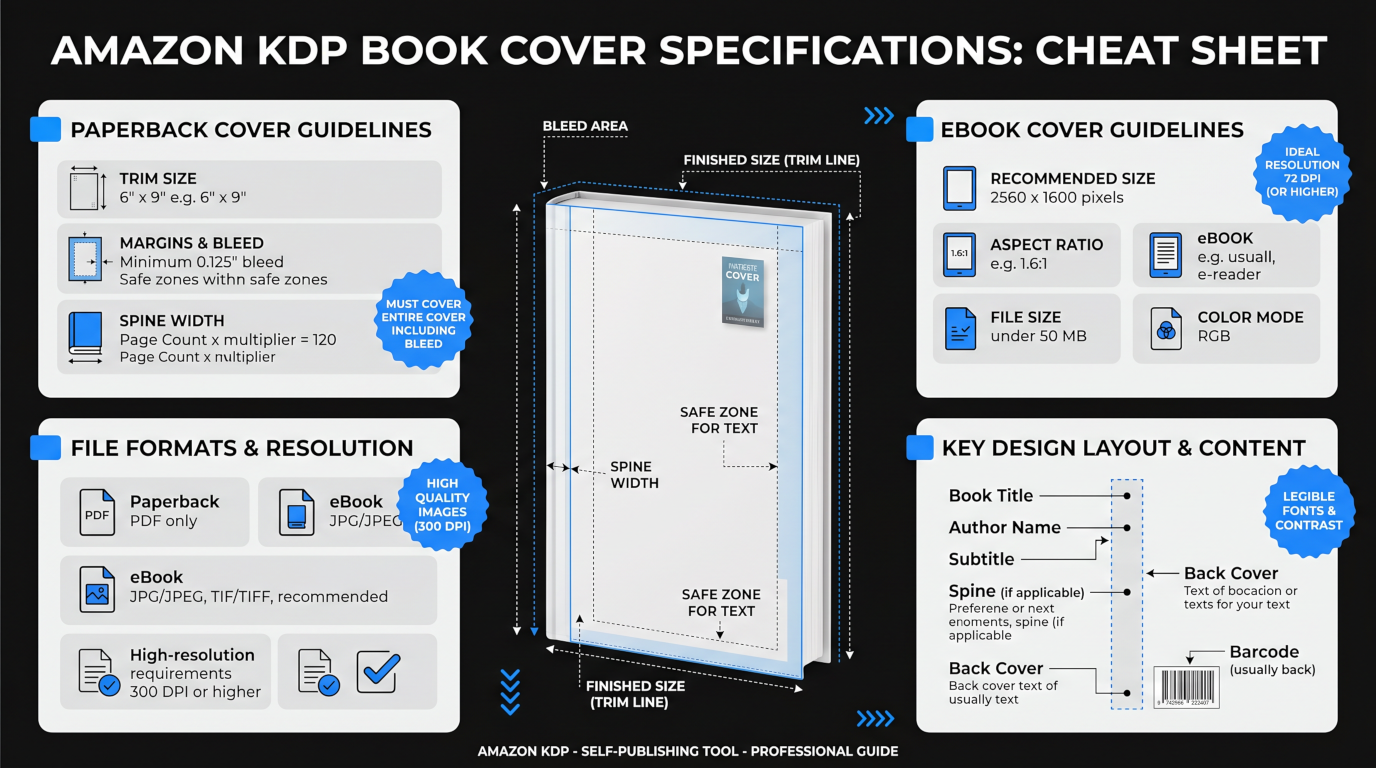
Amazon recommends a height-to-width ratio of 1.6:1. The ideal size is 2560 x 1600 pixels. This displays crisply on all Kindle devices, phones, tablets, and the Amazon store thumbnail.
Minimum acceptable size is 1000 x 625 pixels. Anything smaller will look blurry on high-resolution screens and may be rejected during upload.
File Format
Upload your ebook cover as either JPEG or TIFF. JPEG is the standard choice for photographic covers. TIFF is acceptable but creates larger file sizes with no visible quality benefit for web display.
Resolution
Your cover should be built at 72 ppi or higher. Since the recommended dimensions are pixel-based, working at 300 ppi during design is smart, then export to the final pixel dimensions. Do not upscale a small image to 2560 x 1600. Start big and compress down.
Color Space
Use RGB color mode. Amazon's display systems are RGB-based. CMYK files will be converted automatically and can shift colors unpredictably.
Paperback Cover Requirements
Paperback covers are where most authors trip up. Unlike ebooks, a paperback cover is a single wraparound file that includes the back cover, spine, and front cover in one continuous image.
Understanding Trim Size and Bleed
Trim size is the final dimensions of your printed book after the edges are cut. KDP offers standard trim sizes ranging from 5 x 8 inches to 8.5 x 11 inches. Your cover must be sized precisely for your chosen trim size.
Bleed is the area that extends beyond the trim line so the printer can cut without leaving white edges. KDP requires 0.125 inches (3.2 mm) of bleed on all outside edges. This means your cover image must extend 0.125 inches past the final trim line on the top, bottom, and outer sides.
Spine Width Calculation
Your spine width depends on your page count and paper type. Use this formula:
Spine width = (Page count / Paper PPI) + 0.06 inches
KDP white paper is approximately 55 PPI (pages per inch). Cream paper is approximately 50 PPI. Add 0.06 inches as the standard allowance for cover thickness.
For example, a 300-page book on white paper has a spine of roughly 0.55 inches. That exact number must be built into your cover file or the text on your spine will be off-center.
Safe Margins
Keep all text and critical design elements at least 0.25 inches inside the trim line. This prevents anything important from being cut off during production. For barcode areas on the back cover, leave the bottom right 2 x 1.8 inches free of text or complex backgrounds.
Hardcover Cover Requirements
Hardcover covers follow the same basic principles as paperbacks, but with a few critical differences.
KDP hardcover covers require a 0.375 inch bleed on all outside edges, not 0.125 inches. The wraparound must also include the hardcover case wrap, which means the back cover, spine, and front cover dimensions are slightly larger than their paperback equivalents. You must download the hardcover template directly from KDP for your specific trim size and page count, do not reuse a paperback template.
Hardcover spines are slightly wider than paperbacks due to the binding board. Always generate the cover template from the KDP Bookshelf for your exact book specs.
File Format and Technical Specifications
Your print cover must be a PDF file. KDP does not accept JPEG, PNG, or TIFF for print covers. The PDF must be print-ready, with all fonts embedded and images at full resolution.
For both print and ebook, avoid these technical errors:
- Do not use transparency in print covers. Flatten all layers.
- Do not embed low-resolution stock images scaled up beyond 100%.
- Do not use spot colors or special inks. Stick to standard CMYK or RGB process colors.
- Do not add crop marks, registration marks, or color bars. KDP handles all production marks.
The Complete KDP Cover Specs Cheat Sheet
Use this table as your quick reference before every upload.
| Spec | Ebook | Paperback | Hardcover |
|---|---|---|---|
| Dimensions | 2560 x 1600 px (ideal) | Trim size + 0.125″ bleed | Trim size + 0.375″ bleed |
| Aspect Ratio | 1.6:1 | Varies by trim size | Varies by trim size |
| Resolution | 72 ppi minimum (300 ppi recommended for design) | 300 ppi minimum | 300 ppi minimum |
| File Format | JPEG or TIFF | ||
| Color Mode | RGB | CMYK or RGB | CMYK or RGB |
| Bleed | None | 0.125″ on all outside edges | 0.375″ on all outside edges |
| Spine | N/A | Calculated by page count and paper type | Calculated by page count (wider than paperback) |
| Safe Margin | Keep text central | 0.25″ inside trim line | 0.25″ inside trim line |
| Barcode Area | N/A | Leave 2 x 1.8″ bottom right clear | Leave 2 x 1.8″ bottom right clear |
Common Mistakes That Get Covers Rejected
Here are the errors that show up most often in KDP support queues. Avoid them and your review time drops from days to hours.
1. Wrong spine width. Authors guess the spine or use a template from a different page count. Always calculate from your exact final page count after formatting.
2. Missing bleed. Designers build the cover to the exact trim dimensions and forget the 0.125 inch extension. The result is a white strip after cutting.
3. Low-resolution images. A 72 ppi image stretched to fill a print cover will look pixelated and blurry. Source images must be 300 ppi at their printed size.
4. Text too close to the edge. Bleed and safe margins are not the same thing. Bleed extends the image. Safe margin keeps text away from the blade.
5. Using RGB for print without checking. While KDP accepts RGB, colors can shift during conversion. If color accuracy matters, design in CMYK and convert to RGB for ebook.
Quick Templates and Formulas
Download your official cover template directly from the KDP Bookshelf for every book. It is free and exact. But if you want to build your own file or check a designer's work, use these formulas.
Paperback cover width = Back cover width + Spine width + Front cover width + Bleed
Paperback cover height = Trim height + (Bleed x 2)
For a 6 x 9 inch paperback with 200 white pages:
- Spine = (200 / 55) + 0.06 = ~3.7 inches
- Cover width = 6 + 3.7 + 6 + 0.25 = 15.95 inches
- Cover height = 9 + 0.25 = 9.25 inches
At 300 ppi, that equals a pixel dimension of 4785 x 2775 pixels. Build at that size, export as PDF, and you are set.
Build Your Cover Without the Headaches
Knowing the specs is half the battle. The other half is having a cover that sells. If you want to skip the design software learning curve and generate a professional, spec-compliant cover in minutes, AI Promo Toolkit's Ecover Pro engine is built for KDP authors. It handles the dimensions, the bleed, and the visual psychology so you can focus on writing the next book.
Stop wrestling with templates and start publishing.
